


How To Choose A Home Builder In WA: What Every Custom Home Client Should Know
Most people building in the Great Southern live in Perth, deciding on a builder for a block they cannot easily visit. This page shows you how builders fail, what protects you when one does, and how to test any builder before you sign.
.svg)
Renovation and Extension $600-$750K
.svg)
.svg)
WA, Member 7 Years
.svg)
Projects to $1.5M
.svg)
and the Great Southern Region
Why Do Home Builders Fail, And How Would I See It Coming?
Builder failure is real and mechanical, and it usually shows up in the finances and the process well before it reaches the site.
Construction has accounted for around a quarter of all Australian company insolvencies in recent years, the largest share of any industry. The mechanics are consistent: fixed prices signed before costs moved, thin margins multiplied across too many projects, and cashflow that pays trades before the money comes in. In WA, though, registered building contractor failures are a small fraction of those headlines, fewer than one per cent of registered contractors.
Headlines about building company collapses are real, but unscoped. The national "construction insolvency" figures sweep in earthmovers, trade contractors and service firms. WA's regulator, Building and Energy, has published its own analysis of what that means for the businesses actually allowed to sign your building contract:
.svg)

Under one per cent
Insolvencies among registered WA building contractors run at under one per cent of all registered contractors.

A small slice of the headlines.
Registered builders account for less than a fifth of the WA failures counted in the national construction figures.
The risk deserves your attention, not your panic. And it has mechanics you can check. Builds fail for four reasons, and the first one is the most common.

The builder was wrong for the site.
Priced before the bushfire rating and ground conditions were known, the quote was an opening position, not a price. The gap comes back to you as variations and redesign.
- Around half the blocks here carry a bushfire rating.
- The ground runs from granite to fill, and that shows up in the footings.

The builder fell ill or died.
A sole builder can fall seriously ill or die mid-project. That is not a flaw in small builders. It is exactly the event home indemnity insurance exists for, covered next.

The fit was never tested.
No register screens for whether a builder suits how you need to work. The questions later in this guide do.
- A contract type that did not match how the owner needed to manage money.
- A communication rhythm that left a remote owner in the dark.

The money runs out before the build does.
A builder who signed fixed prices before costs rose is finishing those homes at a loss, and the losses get paid from newer clients' deposits and claims. The structure holds until new signings slow. You will not see it in the carpentry.
You will see it in the finances:
- Pressure for money ahead of work done
- Claims that do not match progress on site
- A project load that keeps growing
.svg)
How Do I Check If A Builder Is Registered In WA?
Every WA builder holds a registration you can verify online in minutes, and you should, before any other conversation.
Search the builder's name or registration number on the Building and Energy licensed practitioner search. Registration with the Building Services Board is what legally allows a person or company to contract for building work in WA, and registered contractors must meet financial requirements set by regulation. If the name on your quote does not match a current registration, stop there.
Two things make this check worth more than it looks.
Registration is tied to financial standing, not just competence.
The State Administrative Tribunal can cancel a registration, and the Building Services Board can refuse to renew one, where a builder fails the financial requirements set under WA law. A current registration is not a solvency guarantee, but a builder operating without one is a walk-away signal with no exceptions.

The entity matters as much as the name.
Check the registered entity is the same entity on your quote, your contract and, later, your insurance certificate. A familiar trading name over an unfamiliar company is worth a direct question.
What registration does not tell you: how many projects the builder is carrying, what their margins look like, or whether they suit your build. Those answers come from the insurance layer and the questions later in this guide.
What Does Home Indemnity Insurance Actually Cover In WA?
If your builder dies, disappears or becomes insolvent, HII pays up to $200,000 to finish or fix the work, and up to $40,000 for a lost deposit.
Home indemnity insurance is compulsory in WA for residential building work over $20,000 that needs a building permit. Your builder must take it out in your name before accepting any money, including the deposit, and a council cannot grant the building permit without it. If the builder dies, disappears or becomes insolvent, it covers completing or fixing the work up to $200,000, and loss of deposit up to $40,000, for six years from practical completion.
Here is the scenario it exists for. You sign a $400,000 contract. The builder completes $300,000 of work, then goes under. A new builder will not finish someone else's job for the $100,000 left on your contract; they price the remaining work from scratch, say at $200,000. HII covers that $100,000 shortfall so the build can be completed without you paying for the same work twice.
The details worth knowing before you rely on it:
Your Name Goes On The Policy.
The builder pays the premium, but the policy is issued in the owner's name and follows the property if you sell within the insurance period.

No Certificate, No Money.
The certificate of insurance must be in your hands before you pay a deposit or any other amount. A builder asking for money first is breaking the law, with penalties up to $50,000.

You Can Verify The Certificate.
HII in WA is issued through QBE, and QBE publishes a Builders Warranty Insurance Certificate Register. Match your certificate against it. Councils do this before granting a permit; you can do it before paying a cent.

It covers cost-plus builds too.
The requirement applies regardless of contract type, and it must be in place before payment or work begins.

The current caps date from October 2022
Payouts were doubled then, to $200,000 for incomplete or defective work and $40,000 for deposits. Older articles, and some builders, still quote the previous figures.

A $500 excess applies,
And the cover runs through construction plus six years from practical completion, including defect claims in that window.

What triggers a claim
HII only responds to four specific events: 1.The builder dies. 2.The builder disappears. 3.The builder becomes insolvent. 4.The builder's registration is cancelled or refused on financial grounds.

Important: HII is not a quality guarantee
It does not pay for poor workmanship while the builder is still trading, and it does not reduce the builder's own liability to you. If the builder is still in business, HII is not the avenue. Quality protection comes from the contract, which is the next layer down.

One regional reality check worth knowing.
The $200,000 completion cap was set with the state's typical contract values in mind. Custom builds in the Great Southern commonly run $800,000 and beyond, so a completion shortfall can exceed the cap.
The insurance is a floor under the loss, not a ceiling on it.
Verify it exists, always. Just do not mistake it for full cover at this region's build values.
The gap is yours to protect.
The distance between the cap and your contract value is the amount you protect by choosing well in the first place. The rest of this page is how.

What Is The Difference Between A Fixed Price And A Cost-Plus Building Contract In WA?
WA law protects the two contract types very differently, and you should know which set of protections you are signing into.
A fixed price contract sets the total before work starts. A cost-plus contract charges the actual cost of the build plus the builder's margin. In WA, the Home Building Contracts Act 1991 attaches strong statutory protections to fixed price contracts between $7,500 and $500,000, but most of those protections do not apply to cost-plus contracts, which the law requires to say so on their face.
Two honest notes worth having before you sign.
The Act's Ceiling Sits Below This Region's Build Values.
At Great Southern custom build values, often $800,000 and up, even a fixed price contract sits above the Act's $500,000 ceiling. At every price point that matters in this region, the contract document itself is doing the protective work either way.
Cost-Plus Shifts The Protection From Statute To Paperwork.
It is not a trick, but the safeguards have to live in the contract. A well-run cost-plus contract carries:
- A detailed written budget before signing
- An agreed margin you can see
- Progress claims backed by the actual supplier invoices
- Defect and review periods written in as clauses, not promises
If a cost-plus builder cannot show you those four things in the document, you are giving up price certainty without getting the safeguards that should come in its place.
What Can I Do If There Is A Problem With My Builder In WA?
WA has a structured complaint pathway through the Building Commissioner, and knowing it before a dispute changes how disputes go.
Defective or unsatisfactory building work in WA can be taken to the Building Commissioner at Building and Energy, who can order the builder to fix or pay for work valued up to $100,000. Complex or higher-value matters go to the State Administrative Tribunal. Complaints must generally be made within six years of the work being completed, or three years for contract disputes.
The sequence runs like this:
Put it in writing to the builder first.
Most defects are resolved here. How the builder responds to a written defect notice is an early signal of how the rest will go.
Serve a notice of proposed complaint.
Before Building and Energy will accept a formal complaint, you must give the builder the prescribed notice at least 14 days in advance. Email is sufficient; keep proof.
Lodge the complaint with the Building Commissioner.
Building and Energy can conciliate, investigate, and issue a building remedy order requiring the work to be fixed or paid for, up to $100,000 without the parties' consent.
Referral to the State Administrative Tribunal.
Intractable or higher-value matters go to the SAT. Against a registered builder the SAT has no monetary cap on what it can order; the $500,000 limit applies only to orders against an unregistered person.
The sequence runs like this:
Fixed price within the Act's range:
The builder must fix defects you notify in writing within four months of practical completion, as a legal minimum. Contracts can provide longer.
Larger or cost-plus builds:
Your defect rights are only the ones written into the contract, which is why they are worth finding and reading before you sign.
Structural problems:
Can be pursued through the complaint pathway for up to six years from completion.
A regional note worth keeping: the regulator is not as far away as it feels from a Denmark or Albany block. The department behind Building and Energy maintains a Great Southern regional office in Albany, reachable on (08) 9842 8366, alongside the statewide Building and Energy line on 1300 489 099.
None of this is a reason to expect a dispute. It is a reason to keep every variation, claim and notice in writing from day one, because the pathway runs on paper.
What Questions Should I Ask A Builder Before Signing A Contract?
Ten questions that test the things registers and brochures cannot. Any sound builder can answer all ten without flinching.
Before signing with any builder, confirm their registration on the Building and Energy search, see the HII certificate in your name before paying anything, and ask: what contract type, what backs each progress claim, how many projects they are carrying, who runs the site day to day, what gets inspected between stages, and what defect and review terms are written into the contract.
.svg)
What is your registration number, and does the registered entity match the one on this quote? (Then check it yourself on the licence search.)
Is this contract fixed price or cost-plus, and does the document say so on its face?
What backs each progress payment? Claims should map to work done or materials supplied, not to the calendar.
Who is on my site day to day, and how often will I see or hear about progress without asking?
What defect and review periods are written into this contract, in clause numbers I can read?
When do I receive the home indemnity insurance certificate in my name? (The only acceptable answer: before you pay anything.)
If cost-plus: show me the written budget, the margin, and how each fortnightly or monthly claim will be evidenced.
How many projects are you running right now, and what is your insurer's cap on your total work in progress?
What gets inspected before each stage moves on, and by whom?
At what point in your process do you want to see my plans? (A builder who wants in before the design is locked is telling you how they think about cost.)
Walk Away Early If You See:
- Any request for money before an HII certificate exists in your name.
- A claim schedule that bills by date rather than by completed work.
- A quote produced without anyone seeing the block.
- A contract that avoids saying what type it is.
- Irritation at any question on this list. The questions are routine, and a builder who bristles at them is showing you how the build will go.
These are the questions, and Michael answers every one of them, with documents, in a Great Southern Build Conversation.
What Does A Financially Sound Builder Look Like In Practice?
Soundness shows up as observable habits: verification offered before it is asked for, money tied to evidence, and a workload kept deliberately inside limits.
A sound builder volunteers their registration number rather than waiting to be asked, produces the HII certificate before requesting a deposit, ties every payment claim to evidenced work, keeps their project load inside their insurer's cap, inspects between stages instead of at the end, writes defect terms into the contract, and tells unsuitable clients no. Each habit is checkable before you sign.
None of these markers is exotic. That is what makes them useful: they
separate builders by behaviour, not by marketing budget.
Verification offered, not extracted.
The registration number sits on the website and the paperwork. The HII certificate arrives before the deposit request, unprompted.
Money follows evidence.
Whatever the contract type, each claim is traceable to work on site or invoices in hand. The schedule serves the build, not the builder's cashflow.
Workload kept inside limits.
Insurers cap how much work a builder can carry at once. A sound builder treats the cap as a discipline rather than a ceiling to negotiate, because over- commitment is the most common road to the failures in Section 03.
Checking built between stages.
Problems caught at frame stage cost little. The same problems found at handover cost far more and damage the relationship. Staged inspection is the habit that separates the two.
Defect terms in writing.
Not "we always look after our clients." Clause numbers.
A willingness to say no.
A builder who takes every job is pricing some of them wrong. The ones who point unsuitable buyers elsewhere are protecting both sides.

Here Great Southern Homes Sits Against This Standard:
.svg)
What Should I Look For In A Builder For A Great Southern Block?
Down here the selection tests get sharper: the order of operations, the trade network, and the honest answer to the Perth-or-local question.
For a build in the Great Southern, test three things in any builder: whether the bushfire rating and ground conditions are settled before the design and the quote, whether the trades on the quote are actually based in the region, and how the builder would manage your site, your callouts and your supply lines from wherever they are based. The block decides what competence looks like; the builder either has it or prices without it.
Watch The Order Of Operations.
Around half the blocks here carry a bushfire rating, and the ground runs from granite to fill. A builder who prices your build before knowing either is guessing, and the guess comes back later as variations. Ask any builder what they check before quoting.
Ask Where The Trades Live.
Regional trade availability is a genuine constraint here, and designs are sometimes drawn around what is available in Perth rather than what can be built locally. Ask any builder to name the trades on your quote and where they are based. Relationships with trades established in the region are the difference between a schedule and a hope.
Then The Question Most Buyers Are Quietly Weighing: A Builder Where You Live, Or A Builder Where The Block Is.
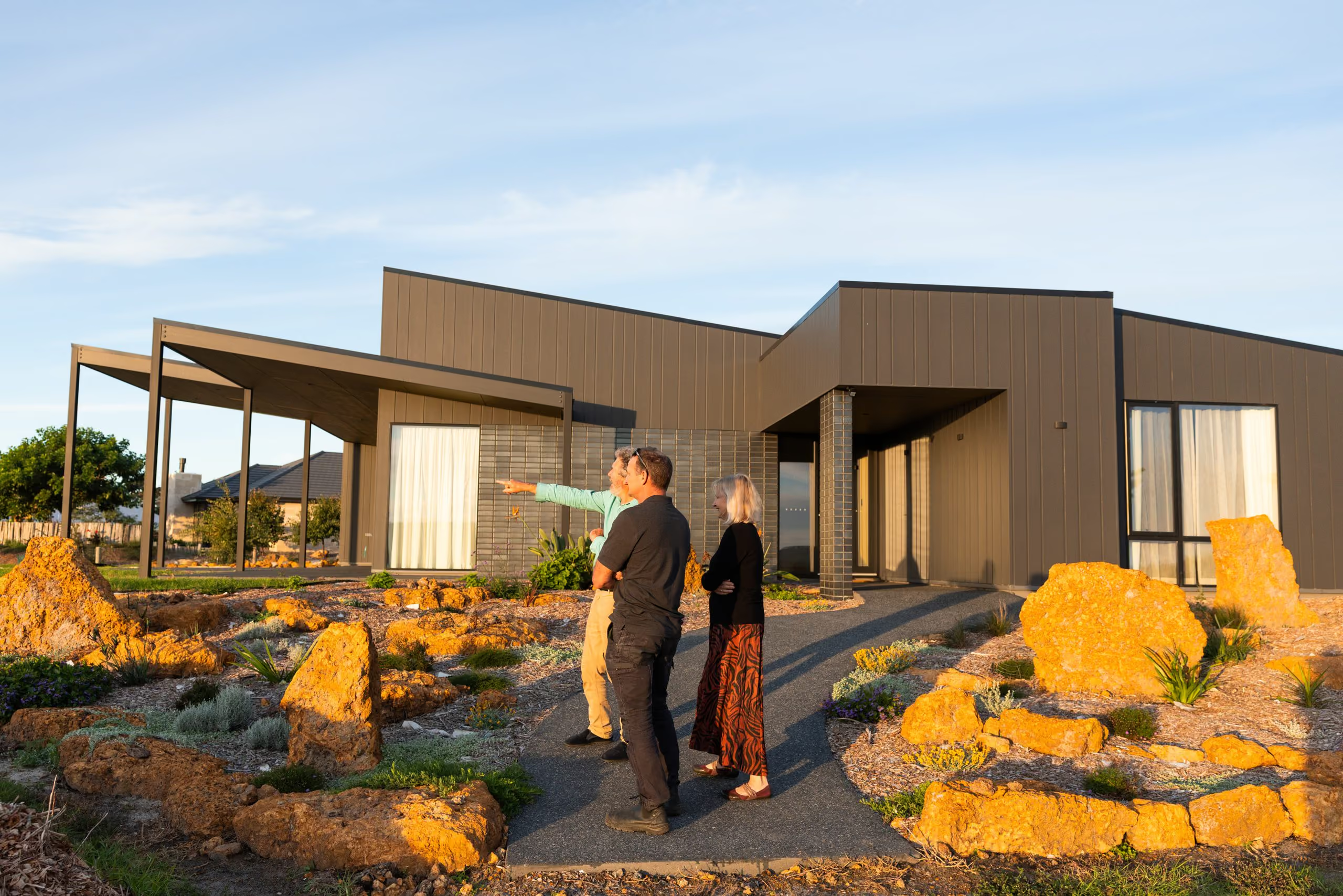
Most people building here live in Perth, and a builder you can meet near home has real appeal. The postcode is not the test. The behaviours are, and they apply to every builder equally:
- Who is physically on the site, how often, and is that person the one accountable to you?
- Where are the trades based, and did the builder secure them or hope for them?
- When something needs attention after handover, what does a callout actually involve
- From where the builder sits?
- Are freight, lead times and regional material availability priced into the quote, or scheduled to be discovered during the build?
A Perth builder with genuine, recent delivery in this region can pass all four, and if one can, you should let them make that case. A local builder should be held to the same four. Nobody passes this test by address alone.
The regional stake behind all of it is blunt. If a build fails partway down here, the pool of replacement builders is thin, and a new builder prices the unfinished work from scratch. That is the exact shortfall home indemnity insurance covers, and the reason getting this choice right the first time is worth more in this region than most.
.svg)
Common questions about choosing a home builder in WA
Your home indemnity insurance responds. The policy, which the law required your builder to take out in your name before you paid anything, covers the cost of completing the work above what remains on your contract, up to $200,000, plus loss of deposit up to $40,000, with a $500 excess. You engage a new builder, the insurer covers the shortfall between their price and your remaining contract balance, and the cover also extends to defective work claims for six years from practical completion. On larger Great Southern builds, be aware the $200,000 cap can sit below the real shortfall, and the regional pool of replacement builders is thin, which is why prevention earns its space on this page. The practical first steps are to stop all payments, gather your contract, certificate and claim records, and contact the insurer named on your certificate.
No, and the difference matters. HII only pays when the builder dies, disappears, becomes insolvent, or loses registration on financial grounds. While the builder is trading, your protections are the warranty and defect terms in your contract and WA's complaint pathway through the Building Commissioner, under which defective work can generally be pursued for up to six years after completion. HII protects you against losing the builder. The contract and the complaint pathway protect you while the builder is still working.
It carries a different risk, not automatically a bigger one. You trade a fixed total for visibility of actual costs, and you trade most of the Home Building Contracts Act's automatic protections, which only attach to fixed price contracts under $500,000, for whatever the contract itself provides. Cost-plus is sound when the contract carries its own safeguards: a detailed written budget before signing, a stated margin, claims backed by supplier invoices, and defect terms in writing. It is risky when those are missing, because then nothing stands behind the price. The law requires a cost-plus contract to identify itself in its heading, so you will always know which type you are reading.
There are real advantages to a Perth builder. They are easy to meet, you can visit their office and past projects, and an established metro builder may carry deep resources. Those count. But once you are comparing builders who can each answer the practical questions well, local knowledge of the conditions becomes the deciding edge. A builder who already knows how the bushfire ratings, the ground from granite to fill, the freight lead times and the regional trades actually behave is pricing from experience, not estimate. Ask any builder who will be on your site day to day, where the trades on the quote are based, how an after- handover callout works from their location, and whether regional lead times are priced in. A Perth builder can answer all four well. A builder who lives with these conditions usually answers them with less guesswork.
Search the builder's name or number on Building and Energy's licensed practitioner search, which is free and public. Confirm the registration is current and that the registered entity matches the entity on your quote and contract. Building work in WA can only be contracted by a registered building contractor, and a mismatch between the name you have been dealing with and the registered entity is a question to resolve before anything else.
Renovation and Extension $600-$750K
Insurance Held
Full Invoice Transparency
.svg)
.svg)
The most expensive part of a build is choosing the wrong builder
Get it wrong and you carry the cost for years. Bring the ten questions to Michael Smyth and see the registration, insurance certificate and contract terms before you commit a dollar.
Your block. Your questions. Straight answers, whichever builder you pick.